Why Ultra-Low Medigap Rates Can Cost More Later
Find An Agent
Search your ZIP code to find trusted Medicare agents near you.
Trusted by Thousands of Seniors Nationwide

Why Ultra-Low Medigap Rates Can Cost More Later
Those ultra-low introductory rates that sound too good to be true, on insurance premiums, mortgages and other financial products, often are. Low initial pricing usually is not designed to be sustainable based on actual long-term costs. Instead, it is often used to attract new policyholders and drive sales.
For some time, Medigap rates have been driven by market uncertainty and high benchmarks, making it especially important to plan ahead and anticipate likely rate corrections in the years ahead.
Understanding Ultra-Low Introductory Rates
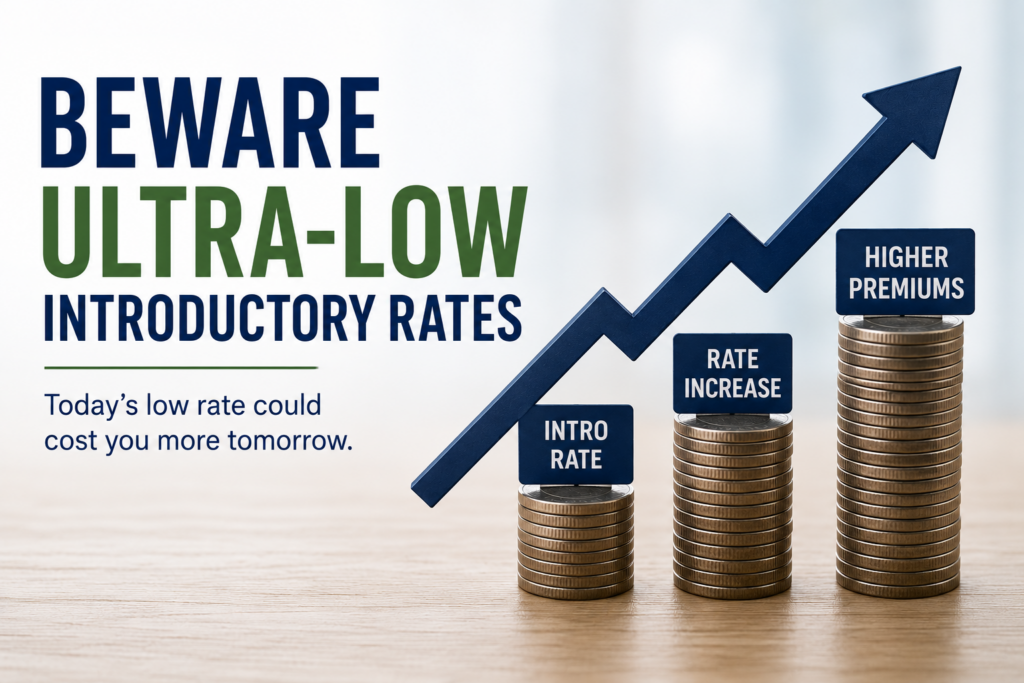
An ultra-low introductory rate is a temporarily low price offered on Medicare Supplement plans and other financial products as a way to attract potential customers. Also known as teaser rates, ultra-low introductory rates are found in many industries, particularly insurance and lending.
These rates are often deliberately set below the ongoing cost of the product and are intended to be reset after the promotional period — often to a much higher rate.
Common examples include:
- Adjustable-rate mortgages
- Promotional credit cards with ultra-low APRs
- Short-term loan offers and other financial products
- Medicare Supplement plans from new market entrants
Adjustable-rate mortgages and promotional credit cards with 0% APR are familiar examples. Insurance carriers, including new entrants to the Medicare market, can use similar pricing strategies. These carriers may promote new plans with ultra-low rates that appeal to customers but do not fully match the actual cost of claims.
Often, carriers will later raise rates and blame market conditions or rising healthcare costs. In many cases, however, those increases are correcting for initial rate level inadequacy.
Federal Reserve projections indicate interest rates are expected to remain elevated relative to the near-zero rates experienced during the pandemic era. With this baseline in mind, financial and insurance products offering ultra-low rates may not reflect the current rate environment.
Why Carriers Use Ultra-Low Introductory Rates
Ultra-low introductory rates are essentially a loss leader: a product offered below market rates in order to acquire market share quickly. New carriers entering the Medicare Supplement market may use below-cost rates as a customer acquisition strategy, expecting that future rate increases will make up for early losses.
Because Medigap plans are standardized and benefits do not vary from carrier to carrier, ultra-low pricing is one way for a company to stand out. These low rates may not be sustainable if they are based on the assumption that premiums will rise once customers are acquired.
Carriers may frame future increases as necessary to keep up with the cost of healthcare, but those increases may also reflect initial underpricing. Claims experience, investment returns and regulatory requirements all affect long-term premiums, no matter what introductory rate is offered.
High premiums can also drive away healthier beneficiaries, raising costs further and potentially contributing to what is sometimes called a death spiral.
Here’s a quick comparison of sustainably priced vs. teaser-priced plans:
| Sustainably Priced Plan | Teaser-Priced Plan | |
|---|---|---|
| Year One Premium | Market-competitive | Below market |
| Rate Increase Pattern | Gradual and predictable, such as 3%–5% per year | Large corrections, such as 15%–25% or more after the introductory period |
| Carrier Track Record | Established, multi-year rate history | New entrant or plan with limited history |
| Long-Term Cost | Lower cumulative cost over 10+ years | Higher cumulative cost due to catch-up rate increases |
| Policyholder Retention | High, with a stable block of business | Lower, as rate shock can lead to turnover |
The Risk of Rate Resets and Payment Shock
Payment shock occurs when a policyholder’s periodic payment, such as a premium, increases after the introductory period. After paying ultra-low rates initially, a steep rate increase can be a surprise. It may affect your budget, force you to change coverage or even cause you to let your policy lapse.
For example, buyers with adjustable-rate mortgages may experience payment shock when monthly payments increase at the end of the introductory period.
With Medigap, a senior might purchase a plan at a $95 monthly introductory rate, only to see premiums increase by 25% over two years to $119 per month.
Here’s how these increases can compound over time:
- Year 1: Introductory rate of $100 per month
- Year 3: Two catch-up rate increases bring the premium to $130 per month
- Year 5: Additional corrections drive premiums to $170 per month
By comparison, a senior on a sustainably priced plan that starts at $105 per month and increases by $5 each year would pay $125 per month in Year 5.
Unlike loans that can be refinanced or financial products that can be bought and sold, Medigap plans have a lock-in problem. Policyholders often cannot easily switch between Medigap plans without medical underwriting. That can be a problem for those with pre-existing health conditions who bought into a low-priced plan and are now stuck with it.
How 2026 Interest Rate Trends Impact Insurance and Borrowing
Insurance trends cannot be separated from the larger macroeconomic landscape. With interest rates remaining higher than pandemic-era lows, it can be risky to chase ultra-low introductory rates and assume they will not rise later.
Higher interest rates can affect insurance carriers, including their investment portfolios and financial reserves. While investment income may increase, healthcare costs and claims expenses can also rise. Inflation in medical services may lead to steep premium increases.
Not all insurers face the same risks, so pricing and underwriting decisions will vary. Medigap premium increases in 2026 are likely to be affected by multiple factors.
Volatility could increase if rates remain elevated, making an ultra-low Medigap premium riskier than it would be in a more favorable cost environment.
Practical Tips to Avoid Surprises from Rate Increases
Some Medigap rate increases are unavoidable, but there are ways to reduce surprises. Follow these steps to avoid falling into the trap of ultra-low introductory rates:
- Look beyond the first year. A teaser rate may be appealing, but it should be put into context by reviewing the carrier’s five-year or 10-year rate increase history. Ask for rate adjustment data by state and plan type. If there is no history, there may be insufficient data to inform your decision.
- Examine your budget. Give your budget a stress test by projecting worst-case scenarios. Estimate what your premium would be after three years of 15%–25% rate increases. Would your budget be able to handle it?
- Check the carrier’s time on the market. The more time an insurance carrier has been in the Medigap market, the more likely it is to have meaningful pricing data. Its rates may be higher initially, but they may deliver lower costs over time.
- Do not forget underwriting. If payment shock sets in after your introductory period ends, it can be tempting to switch policies. But switching Medigap policies may require medical underwriting. This could limit your options if your health has changed after enrollment.
- Consult a Medigap advisor. An independent agent or advisor can help you compare a carrier’s historical rate data, not just current premiums. AAMSI | MedicareSupp.org provides resources and an agent directory to help consumers find support and make informed Medigap decisions.
- Learn from fixed-rate products. Treasury bonds, CDs and high-yield savings accounts offer stable returns in a volatile market. The same principle applies to Medigap: a carrier with a predictable rate increase trajectory may be better than a highly variable one.
Planning Your Budget Around Potential Rate Changes
2026 is a year of rate uncertainty, not a return to the ultra-low rates of just a few years ago. Treat ultra-low offers as temporary promotions: convenient but not permanent.
Whether you are comparing insurance premiums, mortgages or another financial product, the following framework can help stress-test your budget:
| Budget Category | Conservative Estimate | Stress-Test Estimate |
|---|---|---|
| Medigap Monthly Premium | Current rate plus 5% per year | Current rate plus 15%–20% per year |
| Mortgage or Loan Payment | Current fixed rate | Post-reset adjustable mortgage rate, plus 2%–3% |
| Savings Yield | Current APY minus 1% | APY falls to 2.50% |
| Out-of-Pocket Costs | Medicare.gov estimate | Estimate plus 10% inflation buffer |
High-yield savings accounts are a key component of many retirement plans, with some seniors relying on higher interest rates to offset the impact of increased premiums. Seniors should account for potential changes in savings yields when determining the impact of premium increases on their budgets.
Review your Medigap policy annually to ensure your carrier’s rate trajectory is competitive with similar insurers, not necessarily with ultra-low introductory rate plans. Use AAMSI | MedicareSupp.org resources to research Medigap policies and evaluate carrier stability over time.
Interest rates can move up or down. A forward-looking budget that can handle dramatic swings, rather than relying on a temporary ultra-low rate, provides more financial stability for seniors.
Frequently Asked Questions About Rate Increases and Introductory Offers
Some Medicare Supplement plans aim to attract new policyholders with initial premiums that are below sustainable levels. These plans often see steep rate increases after the first few years because low initial rates typically lead to rate corrections. Premium increases can exceed those of more established plans with sustainable pricing.
What is payment shock and how does it affect Medigap policyholders?
Payment shock occurs when your periodic Medigap payment increases substantially after an initial low-rate period ends. This can mean an unexpected jump in premiums, often by 20% or more, straining budgets and requiring difficult decisions about coverage.
Should I switch to a new Medigap plan just because it has a lower rate?
Not always. Low introductory rates can be appealing, but they do not guarantee low costs over the long term. It is more important to review the carrier’s market tenure, financial stability and historical rate increases before switching. If you switch, you may also have to go through medical underwriting if you want to switch again later.
The Federal Reserve does not directly set Medigap premiums, but its decisions affect broader economic forces, including inflation, healthcare costs and labor markets. These factors, along with interest rates, can play a role in Medigap pricing.
What does “initial rate level inadequacy” mean in insurance?
Initial rate level inadequacy means a carrier’s premiums are lower than needed to account for anticipated expenses and claims. The carrier may later raise rates after acquiring a base of customers, often describing the increase as a response to rising healthcare costs.
Is 2026 a good year to lock in a fixed-rate financial product?
Locking in a fixed-rate financial product in 2026 may be wise for consumers who want more budget predictability. The same principle can apply to Medigap: choosing a stable premium trajectory is often better than chasing a low introductory rate that may rise later.
How can I evaluate whether a Medigap carrier’s rates are sustainable?
You can evaluate sustainability by reviewing the carrier’s historical rate increases, comparing rates by state and plan type, reviewing financial strength ratings and consulting with an independent Medicare Supplement agent. A carrier with a longer, more predictable rate history may offer greater long-term stability.
If your Medigap premiums increase significantly, review your carrier’s history of rate increases to determine whether the increase appears to be a one-time correction or part of an ongoing pattern. Then compare your plan with alternative options. Keep in mind that switching policies may require medical underwriting.
Before choosing a Medicare Supplement plan, consult a local Medicare agent who can explain your options and help you evaluate long-term value, not just the lowest premium.
Related Medicare guides