
Are Medicare Premiums Tax Deductible in 2027?
Find An Agent
Search your ZIP code to find trusted Medicare agents near you.
Trusted by Thousands of Seniors Nationwide

Are Medicare Premiums Tax Deductible in 2027?
Tax treatment can change the after-tax cost of Medicare coverage, but it should usually be a secondary consideration when choosing a plan for 2027. Start with doctors, prescriptions, benefits, premiums, and expected out-of-pocket costs. Then check whether premium deductions, the self-employed health-insurance deduction, or an HSA changes the comparison.
A premium that qualifies as a medical expense does not create a dollar-for-dollar tax credit. Most people receive a Schedule A benefit only if they itemize and their total unreimbursed medical expenses exceed 7.5% of adjusted gross income (AGI). Many people will get no additional federal tax benefit from choosing a plan with a higher premium.
Use the official Medicare Plan Finder to compare 2027 options and the current Medicare costs to confirm government-set premiums. This guide shows where federal tax treatment fits into that decision.
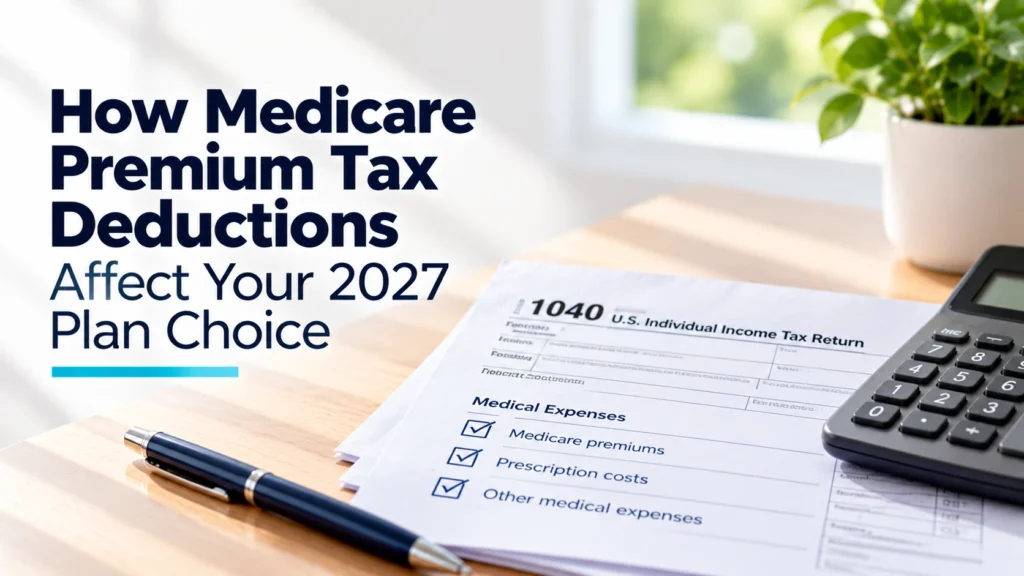
Start With the 2027 Coverage Decision
For each option, compare four numbers: total annual premiums, likely medical cost sharing, expected prescription costs, and any tax benefit you can realistically use. Under IRS Publication 502, Medicare premiums paid with after-tax dollars can generally count as medical expenses. That may include Part A premiums you pay, Part B, Part D, Medicare Advantage, and Medicare Supplement insurance. For context on supplement pricing, see our 2026 Medicare Supplement cost guide.
Here is how common Medicare costs should enter a 2027 plan comparison:
| 2027 cost | Federal tax treatment | Plan-choice implication |
|---|---|---|
| Part A premium | Generally a medical expense if you pay it | Most people pay $0. Include only an actual premium you expect to pay. |
| Part B and IRMAA | Generally medical expenses | Usually continues whichever coverage path you choose; include it in every comparison. |
| Part D premium and IRMAA | Generally medical expenses | Compare the premium with formulary coverage and total drug costs, not tax treatment alone. |
| Medicare Advantage premium | Generally a medical expense if paid | A $0-premium plan has no plan premium to deduct; copayments and other qualifying medical costs may still count. |
| Medigap premium | Generally a Schedule A medical expense | A possible deduction offsets only part of the premium, if any; Medigap premiums cannot be paid tax-free from an HSA. |
| Medical cost sharing | May count if qualifying and unreimbursed | Estimate copayments, coinsurance, deductibles, and maximum out-of-pocket exposure. |
| Reimbursed or pretax amounts | Generally cannot be deducted again | Compare only costs you actually bear after reimbursements or tax-free payments. |
Tax treatment should come after coverage fit. A lower-premium plan can still cost more if your doctors are out of network, your prescriptions are poorly covered, or the plan has higher copayments and prior-authorization requirements. A higher-premium Medigap policy may offer broader provider access and more predictable cost sharing, but a possible deduction recovers only part of the premium—and often none of it.
For Schedule A, only the portion of qualifying, unreimbursed medical expenses above 7.5% of AGI is deductible. AGI is calculated before the standard or itemized deduction. Premiums and other expenses reimbursed by insurance, an employer, an HSA, or another source cannot be deducted again.
A practical estimate: Multiply AGI by 0.075, total the qualifying medical expenses you expect to pay in 2027, and subtract the threshold. Then compare all itemized deductions with the 2027 standard deduction. Only after both tests does the premium create a Schedule A benefit.
This hypothetical 2027 planning example uses a single filer age 67 with $50,000 of AGI. Replace every amount with actual plan quotes and your own expected medical spending before making a coverage decision.
| Hypothetical 2027 expense | Annual amount |
|---|---|
| Part B and IRMAA paid | $2,500.00 |
| Medigap premium ($170 × 12) | $2,040.00 |
| Part D premium ($30 × 12) | $360.00 |
| Other qualifying medical expenses | $1,200.00 |
| Total qualifying medical expenses | $6,100.00 |
| Less 7.5% of AGI ($50,000 × 0.075) | −$3,750.00 |
| Potential Schedule A medical deduction | $2,350.00 |
The example produces a potential $2,350 medical deduction, not $2,350 of tax savings. At a 12% marginal rate, the maximum federal income-tax reduction attributable to that deduction would be about $282—and only if itemizing beats the standard deduction. A plan should still win on coverage and total expected cost before a possible tax benefit is considered.
Why the Standard Deduction Changes the Answer
Schedule A medical expenses help only when you itemize. Compare total itemized deductions with the standard deduction for the tax year in which the premiums are paid. Because 2027 coverage expenses belong on the 2027 return, use the applicable 2027 amounts and the current Schedule A instructions rather than relying on a prior year’s thresholds.
This is why “tax deductible” and “worth choosing” are not the same thing. A taxpayer who uses the standard deduction receives no separate Schedule A benefit from Medicare premiums. Even an itemizer deducts only the amount above the 7.5% floor, and the tax savings is generally the deduction multiplied by the marginal tax rate—not the full premium.
When comparing a $0-premium Medicare Advantage plan with a higher-premium alternative, do not treat the full premium difference as a tax savings. First estimate whether any of the additional premium would actually become an itemized deduction, then compare the remaining after-tax premium with networks, drug costs, copayments, and the plan’s maximum out-of-pocket limit.
The temporary senior deduction may also be available in 2027. Eligible taxpayers age 65 or older by year-end may claim up to $6,000 each; it begins phasing out when modified AGI exceeds $75,000 for single filers or $150,000 for joint filers, and married taxpayers must file jointly. It is available whether you itemize or take the standard deduction, so it does not make a particular Medicare plan more deductible. Review the IRS senior-deduction guidance.
Tax treatment is more likely to affect the 2027 comparison when:
- You expect a large amount of qualifying, unreimbursed medical spending in 2027
- You pay substantial Medicare premiums or IRMAA and already expect to itemize
- You also have deductible mortgage interest, state and local taxes, or charitable contributions
- You qualify for the self-employed health-insurance deduction or can use existing HSA funds
Run the coverage comparison before enrollment and revisit the tax calculation with actual year-end expenses before filing.
IRMAA and Your 2027 Plan Choice
IRMAA is an income-related amount added to Part B and Part D premiums. Changing Medicare Advantage or Part D plans generally does not eliminate IRMAA because the surcharge is based on income, not the plan’s base premium. IRMAA amounts you pay generally count in the medical-expense total, but Schedule A limits still apply.
IRMAA is generally based on modified AGI from the federal return filed two years earlier. If your income has fallen because of retirement or another qualifying life-changing event, you can ask Social Security to use more recent information by filing Form SSA-44. Read more in our report on rising IRMAA surcharges.
Two Tax Rules That Can Change the Comparison
The self-employed deduction and HSA rules can affect plan costs even when Schedule A does not.
- Self-employed health-insurance deduction: If you have qualifying self-employment income and coverage established under the business, Medicare premiums for you, your spouse, and eligible dependents may qualify. This can include Part A premiums you pay, Part B, Part D, Medicare Advantage, and Medigap. The deduction is claimed on Schedule 1, does not require itemizing, and is not subject to the 7.5% floor. It is limited by earned income from the business and is unavailable for months you were eligible for subsidized employer coverage. Amounts claimed here cannot also be claimed on Schedule A. See IRS Chief Counsel Advice 201228037.
- Health savings accounts: You cannot contribute to an HSA for months you are enrolled in Medicare. When the HSA account beneficiary is 65 or older, existing HSA funds can generally pay Medicare Part A, Part B, Part D, and Medicare Advantage premiums tax-free, but not Medigap premiums. That difference may affect after-tax cash flow when comparing Medicare Advantage with Medigap, but it should not override coverage needs. Because delayed Part A can be retroactive for up to six months, coordinate the last contribution carefully. See IRS Publication 969 and Medicare’s working-past-65 guidance.
A 2027 Plan Selection Checklist
- Add the annual Part B, Part D, Medicare Advantage, Medigap, and IRMAA premiums you expect to pay
- Estimate prescription costs, provider access, copayments, prior authorization, extra benefits, and worst-case out-of-pocket exposure
- Calculate whether Schedule A, the self-employed deduction, or tax-free HSA distributions meaningfully change the after-tax total
Do not select a plan solely for a tax deduction. Plan availability and costs vary by location, and individual tax treatment depends on income, filing status, reimbursements, self-employment structure, and state law. Confirm coverage with Medicare or the insurer and tax treatment with a qualified tax professional.
Use the Medicare Plan Finder for 2027 Medicare Advantage and Part D options during Medicare Open Enrollment, October 15 through December 7. Our guide to lowering Medicare costs in 2027 provides additional comparison steps. Medigap follows different enrollment rules. A licensed agent can explain the insurers they represent, but may not represent every company; free, objective counseling is also available through SHIP. You can get started with an agent here.
Frequently Asked Questions
Usually not for that reason alone. A Schedule A deduction applies only after the 7.5% AGI floor and only when itemizing beats the standard deduction. Compare the plan’s full expected cost, provider access, prescriptions, and benefits first.
Medigap premiums generally count as medical-insurance expenses for Schedule A, regardless of plan letter. The deduction remains subject to itemizing and the 7.5% floor. Medigap premiums cannot be paid tax-free from an HSA.
A $0 plan premium provides no plan-premium expense to deduct, but Part B premiums and qualifying out-of-pocket medical costs may still count. The more important comparison is total expected spending, including copayments, prescriptions, networks, and the plan’s maximum out-of-pocket limit.
Premiums you actually pay generally count in the medical-expense total, including Part D IRMAA. If a Medicare Advantage plan reduces your Part B premium, include only the net amount you paid. Schedule A limits still apply.
Can an HSA make one Medicare option cheaper after tax
Possibly. If the HSA account beneficiary is 65 or older, HSA funds can generally pay Medicare Part A, Part B, Part D, and Medicare Advantage premiums tax-free, but not Medigap premiums. Compare that tax treatment with the coverage and cost differences between the plans.
Does IRMAA change when I switch plans
Generally, switching plans does not remove IRMAA. The surcharge is based on income and is added to Part B and Part D costs. A qualifying life-changing event may support a request for Social Security to recalculate it.