
Switching Medicare Supplement Plans During AEP
Find An Agent
Search your ZIP code to find trusted Medicare agents near you.
Trusted by Thousands of Seniors Nationwide

Switching Medicare Supplement Plans During AEP
Medigap policyholders can switch Medicare Supplement plans during the Annual Enrollment Period, but AEP itself does not create a Medigap enrollment right. A Medigap switch can be made at any time of year and, outside a protected window, is subject to medical underwriting no matter what the calendar says.
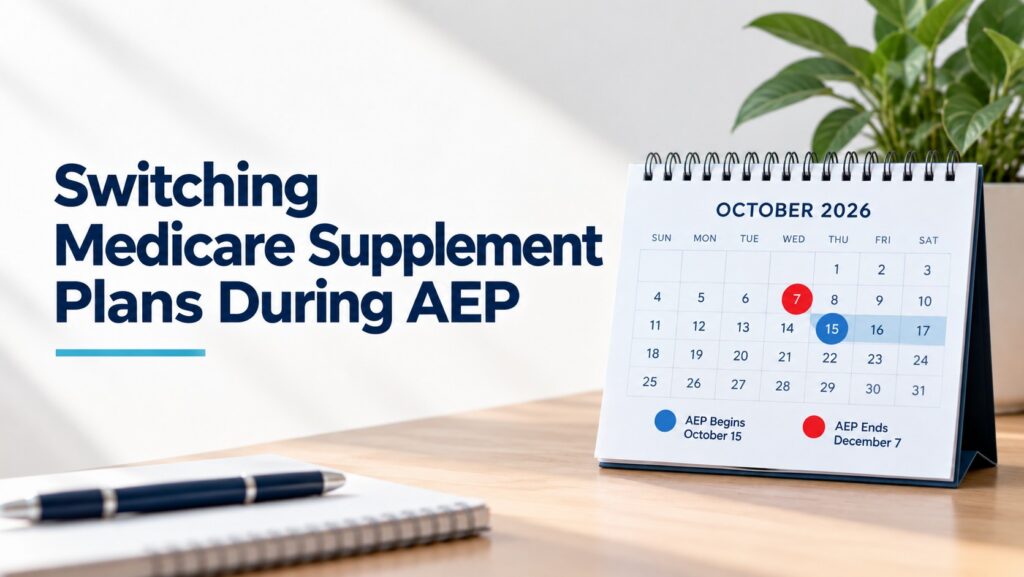
The Medicare Annual Enrollment Period runs from October 15 through December 7 each year. For 2027 coverage, that means October 15 through December 7, 2026, with changes taking effect on January 1, 2027. The window applies to Medicare Advantage and Part D prescription drug plans. It does not apply to Medicare Supplement insurance.
That distinction is lost on many beneficiaries. Each fall, agents field calls from Medigap clients who assume “open enrollment” is their one chance to change plans, along with calls from Medicare Advantage enrollees who want to move to Original Medicare and a Medigap plan before the year ends.
The result is that AEP often prompts Medigap switching activity even though no Medigap deadline is attached to it. Annual Notice of Change letters, Medicare Advantage plan exits, Part D formulary changes and Medigap rate increase notices all tend to land in the same eight-week stretch.
Agents who understand which rules govern a Medigap switch, which deadlines are real and which are assumed, can turn that seasonal activity into properly placed business.
The Agent Perspective
A carrier-to-carrier Medicare Supplement switch generally involves a replacement policy. A same-carrier plan change may be handled differently, depending on the carrier and state. Compensation is not determined by federal Medigap rules; it depends on state law and the agent’s contract with the carrier. For agents with a mature Medigap book, AEP is often a productive time to discuss coverage with clients.
The complication is that two separate rule sets are in play at once. Ordinary Medicare Advantage and Part D elections made during AEP carry a December 7 deadline and take effect January 1. Medigap changes carry no AEP deadline, may require underwriting and can take effect on whatever date the carrier approves.
Mixing the two creates problems. A client who disenrolls from Medicare Advantage during AEP without an approved Medigap application may enter the new year with Original Medicare alone. When more than one Medigap enrollment path may apply, agents should compare the available plans, premiums and carrier requirements without assuming that guaranteed-issue status produces a particular premium or commission result.
Knowing which path applies to each client, underwritten, federal guaranteed issue or a state rule, is the foundation of handling Medigap switches during AEP.
How AEP Rules Differ from Medigap Rules
Medicare Advantage and Part D are federal programs administered through CMS, with uniform enrollment periods nationwide. Medigap is sold by private insurers and regulated at the state level, with federal protections that apply only in specific situations.
The table below summarizes how the enrollment rules compare across the coverage types agents handle during AEP.
| Coverage Type | Enrollment Window | Health Questions | Effective Date | Notes |
|---|---|---|---|---|
| Medicare Advantage | AEP, Oct. 15 – Dec. 7 | None | Jan. 1 | One additional change allowed during MA OEP, Jan. 1 – March 31 |
| Part D Drug Plan | AEP, Oct. 15 – Dec. 7 | None | Jan. 1 | Late enrollment penalty if creditable coverage lapses |
| Medigap, Underwritten Switch | Any time of year | Yes | Set by carrier, usually first of a month | Carrier may decline or charge more. A pre-existing-condition waiting period may apply only in limited circumstances, with prior coverage credited as required |
| Medigap, Federal Guaranteed Issue | Tied to the qualifying event; generally no later than 63 days after prior coverage ends | May be asked, but cannot be used to deny coverage or change the price | Set by carrier; can align with Jan. 1 when coverage ends Dec. 31 | Limited to specific plan letters in most situations |
| Medigap, State Birthday Rule | Annual window tied to the client’s birthday | State-specific; medical underwriting is barred for an eligible switch | Set by state and carrier | Only in Birthday Rule states; falls during AEP by coincidence for some clients |
| Medigap Open Enrollment Period | Six months, beginning the month the client is 65 or older and enrolled in Part B | May be asked, but cannot be used to deny coverage or charge more because of health | Set by carrier | One-time window; not repeated annually |
For a full rundown of the enrollment periods and protections in effect for the coming year, read Medicare Enrollment Rights 2027: Dates, Rules and Protections.
Four Ways a Medigap Switch Can Happen During AEP
A Medicare Supplement switch written during AEP generally falls into one of four categories. Identifying the category before quoting determines the application, the plan letters available and whether medical underwriting is permitted. Compensation must be confirmed separately under the carrier contract and applicable state law.
1. Medigap Open Enrollment Switch
A client’s one-time, six-month Medigap Open Enrollment Period begins the first month the client is both 65 or older and enrolled in Medicare Part B. If that period overlaps AEP, the client may buy any Medigap policy the carrier sells in the state without being denied or charged more because of health. An application may still contain health questions, but the carrier cannot use the answers for medical underwriting during this protected period.
2. Medically Underwritten Switch
Any Medigap policyholder can apply to a different carrier, or for a different plan letter with the same carrier, at any time. Outside a protected window, the carrier reviews the client’s health history and may approve the application at a standard or preferred rate, approve it at a higher rate or decline it.
Health questions and look-back periods vary by carrier. A client declined by one insurer may be approved by another, which is one reason multi-carrier contracting matters during AEP.
For clients who can pass underwriting, this path may provide access to additional carriers, rates or plan options. Premiums and agent compensation still depend on the carrier, state and applicable contract, so neither should be assumed from the issue basis alone.
3. Federal Guaranteed-Issue Switch
Federal law gives Medicare beneficiaries the right to buy a Medigap policy without underwriting in specific situations. Several of them cluster around AEP:
- A Medicare Advantage plan leaves Medicare, stops serving the client’s area or is not renewed for the coming year. Non-renewal notices are generally mailed in early October, just before AEP opens.
- A client joined Medicare Advantage or PACE when first eligible for Medicare Part A at 65 and wants to return to Original Medicare within the first 12 months (Trial Right #1).
- A client dropped a Medigap policy to try Medicare Advantage for the first time and wants to return within 12 months (Trial Right #2).
- A client’s Medigap insurer goes bankrupt or the client leaves a plan because the insurer misled them or failed to follow the rules.
In most federal guaranteed-issue situations, the client’s choices are limited to Plan A, B, D, G, K or L from any insurer selling those plans in the state. Clients who were eligible for Medicare before January 1, 2020, may also choose Plan C or Plan F. Trial Right #1 is broader and allows any Medigap plan sold in the state.
The guaranteed-issue window for a plan termination can open as early as 60 days before coverage ends and closes no later than 63 days after it ends. For a plan ending December 31, that means a window running from roughly the beginning of November into early March. The agent does not have to force the Medigap application through before December 7.
For more on this scenario, read Is Medigap Available If Your Medicare Advantage Plan Terminates.
4. State Rule Switch
Some states give Medigap policyholders their own protected windows. The most common is the Birthday Rule, which lets eligible policyholders switch to a plan with equal or lesser benefits each year around their birthday without underwriting. Clients born in October, November or December in those states will have a Birthday Rule window that overlaps AEP.
Other states provide broader protections, but the rules are not uniform. New York requires continuous open enrollment, Connecticut generally bars denial or health-based pricing, and Maine permits certain year-round switches to plans with the same or lesser benefits when its continuity requirements are met. Vermont uses community rating and restricts medical underwriting in rating, but it should not be treated as having the same continuous enrollment rule as New York. Agents should verify current rules with the applicable state department of insurance before advising clients.
For a state-by-state breakdown, read The Medigap Birthday Rule: A Guide for Agents.
Why AEP Still Drives Medigap Switching
If AEP has no bearing on Medigap enrollment rules, why does so much Medigap switching happen in the fall? Several things arrive at once.
Annual Notice of Change letters. Medicare Advantage and Part D enrollees receive their ANOC before AEP opens. Premium increases, benefit cuts and network changes prompt some enrollees to leave Medicare Advantage altogether, and those who return to Original Medicare generally want a Medigap plan to go with it.
Plan exits and non-renewals. When a Medicare Advantage plan leaves a county, affected enrollees who return to Original Medicare receive a guaranteed-issue right to Medigap. In a year with significant plan exits, this can generate a wave of guaranteed-issue Medigap applications concentrated in the fall.
Medigap rate increase notices. Many Medigap carriers implement rate increases at the policy anniversary or at the start of the calendar year. A notice that arrives during AEP often prompts a client to ask whether a better rate is available, even though the Medigap switch itself is not tied to the AEP calendar.
Part D changes. Medigap clients also hold stand-alone Part D plans, which must be reviewed by December 7. The Part D review conversation frequently becomes a Medigap review conversation.
Client expectations. Years of AEP advertising have trained beneficiaries to think about coverage in the fall. Many Medigap policyholders will not initiate a plan review at any other time of year.
For a look at how rate activity is shaping client behavior, see Medigap Rate Increases in 2026.
Plan Letter Considerations When Switching
The plan letter a client currently holds affects which switches are available and whether underwriting applies.
Plan C and Plan F are closed to anyone who became eligible for Medicare on or after January 1, 2020. Clients who already hold Plan F can keep it, and clients who were eligible before 2020 can still buy it. For everyone else, Plan G is the closest available substitute, with Plan N the most common lower-premium alternative.
Moving from Plan F to Plan G is a move to lesser benefits, so it qualifies under most Birthday Rules. Outside a Birthday Rule state or a federal guaranteed-issue situation, that same move generally requires underwriting. Moving from Plan N or High-Deductible Plan G up to standard Plan G is a move to greater benefits and almost always requires underwriting.
Agents comparing options for clients during AEP can use Compare Medigap Plan G and Plan N and How to Compare Medigap Plans with 5-Year Premium Planning as reference points.
Step-by-Step Agent Workflow for AEP Medigap Switches
The most common AEP Medigap errors come from treating a Medigap application like a Medicare Advantage election. The following workflow keeps the two on separate tracks.
- Sort every AEP request into its deadline category. Ordinary Medicare Advantage and Part D elections for January 1 coverage must be submitted by December 7; Special Enrollment Periods and the Medicare Advantage Open Enrollment Period have different deadlines. Medigap applications are not tied to the AEP deadline.
- Identify the switch type before quoting: underwritten, federal guaranteed issue or state rule. Document the basis in the client record.
- For guaranteed-issue clients, obtain the qualifying document, such as the plan non-renewal letter or proof of Medicare Advantage enrollment date for trial rights, and calculate the window close date.
- For clients outside a protected window, pre-screen health history against carrier underwriting guides before submitting. Consider more than one carrier if the first is likely to decline.
- Confirm the plan letters the client is eligible for, including whether Plan C or F is available based on the client’s original Medicare eligibility date.
- Compare carriers on current premium, rate increase history and rating method, not current premium alone.
- Coordinate effective dates. A client leaving Medicare Advantage December 31 should request a January 1 Medigap effective date. Confirm the carrier will accept a future-dated application and how far in advance.
- When a client uses AEP to leave Medicare Advantage drug coverage effective December 31, enroll the client in a stand-alone Part D plan by December 7 for January 1 coverage. If a plan nonrenewal, the Medicare Advantage Open Enrollment Period or another Special Enrollment Period applies, document the client’s different Part D deadline. The Medigap plan does not include drug coverage.
- Complete the replacement notice required when a client is replacing an existing Medigap policy, and note the correct guaranteed-issue reason code where one applies.
- Do not cancel the existing Medigap policy before the new policy is issued. On the new application, the client must state in writing that they intend to cancel the existing policy.
- Remind the client about the 30-day free-look period. The client may keep both Medigap policies during that period while deciding whether to retain the new one, but must pay both premiums for the overlap.
Commission Impact of AEP Medigap Switches
Medigap compensation is not set by federal Medigap enrollment rules. It depends on state law and the terms of the carrier’s contract with the agent. Issue basis, replacement status and whether the change stays within the same carrier may affect the result.
Underwritten Switches
A carrier-to-carrier underwritten switch may be paid as new business, while some carriers apply a replacement, rewrite or other schedule. Internal plan changes may receive reduced compensation or no new commission. Agents should confirm the contract terms and state requirements rather than assume a particular schedule.
Guaranteed-Issue Switches
Federal Medigap law does not prescribe agent compensation for guaranteed-issue business. Depending on the carrier contract and state law, a carrier may pay its standard schedule, a reduced schedule, a flat fee or no commission. Guaranteed-issue applicants cannot be denied, subjected to a pre-existing-condition waiting period or charged more because of past or present health problems.
For a detailed breakdown of how guaranteed-issue compensation compares to standard-issue, read Understanding Guarantee Issue Commissions.
Chargebacks and Persistency
Switching a client away from a policy written recently may trigger a chargeback on the original policy if it falls within the carrier’s chargeback period. Agents replacing their own business should weigh the chargeback against the new first-year commission before proceeding.
Clients who switch during AEP in a Birthday Rule state may also be eligible to switch again at their next birthday, which can shorten the renewal stream on the new policy.
| Switch Scenario | Underwriting | Typical Commission Treatment | Agent Takeaway |
|---|---|---|---|
| Carrier-to-carrier, underwritten | Required | Often a new-business schedule, but contract terms vary | Compare client value first and confirm both compensation and chargeback exposure |
| Same carrier, plan letter change | Often required for greater benefits; may be waived for lesser | Varies; may be reduced or no new commission | Check carrier rules before recommending; a carrier change may be more favorable |
| Federal guaranteed issue, MA termination | None | Varies by carrier contract and state law | Plan letter choice is limited; verify compensation separately |
| Trial Right #1 or #2 | None | Varies by carrier contract and state law | Document the MA enrollment circumstances and date carefully; the 12-month window is strict |
| State Birthday Rule, overlapping AEP | None | Varies by state and carrier; some states require OE schedule | Treat as Birthday Rule business, not AEP business, for tracking and reconciliation |
Agents should track AEP Medigap switches by issue basis rather than by submission date. A single “AEP” category in a commission tracker can mix Medigap Open Enrollment, underwritten, guaranteed-issue and Birthday Rule policies that may be paid on different schedules, making reconciliation harder than it needs to be.
Common Mistakes with Medigap Switches During AEP
The errors below show up every fall. Most of them come from applying Medicare Advantage logic to Medigap.
Treating December 7 as a Medigap Deadline
Clients, and some agents, rush Medigap applications to beat a deadline that does not apply. The rush can lead to incomplete underwriting pre-screens, missed carrier comparisons and failure to identify the most appropriate protected or underwritten enrollment path.
Cancelling the Old Policy Too Early
A client who cancels an existing Medigap policy before the new one is approved can be left without supplemental coverage if the new carrier declines or delays the application. The existing policy should remain in force until the new policy is confirmed.
Leaving Medicare Advantage Without Medigap Approval
Outside a guaranteed-issue situation, a client who disenrolls from Medicare Advantage during AEP has no guarantee a Medigap carrier will accept them. The Medigap application should be approved, or the guaranteed-issue basis confirmed, before the Medicare Advantage disenrollment is final.
Assuming an ANOC Creates Guaranteed-Issue Rights
A premium increase or benefit reduction described in an Annual Notice of Change does not by itself create a Medigap guaranteed-issue right. Only a plan termination, service area exit, contract violation or similar qualifying event does.
Forgetting the Part D Plan
A client using AEP to move from Medicare Advantage with drug coverage to Original Medicare and Medigap generally needs to enroll in a stand-alone Part D plan by December 7 for January 1 coverage. Different deadlines apply when the client qualifies for a Special Enrollment Period or uses the Medicare Advantage Open Enrollment Period. A Part D late enrollment penalty generally requires a gap of at least 63 consecutive days without Medicare drug coverage or other creditable prescription drug coverage.
Quoting Plan F to Ineligible Clients
Clients who became eligible for Medicare on or after January 1, 2020, cannot buy Plan C or Plan F regardless of the enrollment path. Confirm the client’s original eligibility date before presenting these plans.
Overlooking a Birthday Rule Window
A client in a Birthday Rule state with a fall birthday may have a no-underwriting window open during AEP. Failing to identify that state protection can unnecessarily limit the plan or carrier options presented to the client. Compensation should be verified separately under the carrier contract and state law.
For the client-facing version of the most common AEP missteps, see Medicare Open Enrollment: The 6 Biggest Mistakes to Avoid.
Preparing the Medigap Book Before AEP
Because Medigap switches are not tied to the AEP calendar, agents can spread the work out rather than absorbing it all in the eight weeks when Medicare Advantage and Part D demand is highest.
- Review Medigap rate increase notices as they arrive and flag clients whose premiums have moved out of line with the market.
- Record each Medigap client’s state, birthday, plan letter, carrier and original Medicare eligibility date so the available switch paths are visible at a glance.
- Identify Medicare Advantage clients in their first 12 months who may want to use a trial right, and note the date the right expires.
- Pull county-level Medicare Advantage non-renewal information as it becomes available each fall and contact affected clients about their guaranteed-issue rights.
- Schedule Medigap plan reviews for healthy clients outside AEP, when carrier processing times are shorter and the client is not also managing a Part D decision.
- Confirm each carrier’s current guaranteed-issue and replacement commission schedules before the season begins.
For guidance on matching plan recommendations to different client situations, read How to Match Medicare Supplement Plans to Client Profiles.
Frequently Asked Questions
Can you switch Medicare Supplement plans during AEP?
Yes. Medigap policyholders can apply to switch plans or carriers during AEP, just as they can at any other time of year. AEP does not add any Medigap enrollment rights, so the application is subject to medical underwriting unless the client is within the one-time Medigap Open Enrollment Period, qualifies for a guaranteed-issue right or has a state protection.
Does the Annual Enrollment Period apply to Medigap?
No. AEP governs Medicare Advantage and Part D elections. Medicare Supplement insurance has its own rules, including a one-time six-month Medigap Open Enrollment Period beginning the first month a person is both 65 or older and enrolled in Part B, federal guaranteed-issue rights tied to specific events and, in some states, an annual Birthday Rule window.
Is there a deadline to switch Medigap plans during AEP?
There is no Medigap deadline attached to December 7. The deadlines that matter are the carrier’s cutoff for a requested effective date and, for guaranteed-issue clients, the close of the guaranteed-issue window, which generally falls no later than 63 days after prior coverage ends.
Can a client switch from Medicare Advantage to Medigap during AEP?
A client can disenroll from Medicare Advantage during AEP and return to Original Medicare effective January 1. Whether they can buy a Medigap policy without underwriting depends on whether they qualify for a guaranteed-issue right, such as a plan termination or a trial right. Otherwise the Medigap application is underwritten.
Which Medigap plans are available under federal guaranteed issue?
In most federal guaranteed-issue situations, the client may choose Plan A, B, D, G, K or L. Clients eligible for Medicare before January 1, 2020, may also choose Plan C or F. Trial Right #1 allows any Medigap plan sold in the state.
Can a client switch from Plan F to Plan G during AEP?
Yes, but underwriting generally applies unless the client is in a Birthday Rule state with an open window or qualifies for a federal guaranteed-issue right. Plan G provides lesser benefits than Plan F, so the move qualifies under most state Birthday Rules.
When does a new Medigap policy take effect after a switch?
The effective date is set by the carrier, usually on the first of a month following approval. Most carriers accept future-dated applications, which allows a January 1 effective date to coincide with a Medicare Advantage disenrollment. Agents should confirm how far in advance each carrier will accept an application.
Does switching Medigap plans reset agent commissions?
A replacement policy may be paid under a first-year, replacement, guaranteed-issue or other schedule, but no single treatment applies nationwide. Compensation depends on state law and the carrier contract, and same-carrier plan changes may be treated differently from carrier-to-carrier replacements.
Should a Medigap client keep the old policy until the new one is approved?
Yes. The existing policy should stay in force until the new policy is issued. The client must state in writing on the new application that they intend to cancel the existing policy, but may keep both policies during the 30-day free-look period while deciding whether to retain the new one. Both premiums must be paid during the overlap.
What if a client is in a Birthday Rule state with a fall birthday?
The Birthday Rule window and AEP will overlap. The Birthday Rule usually offers more flexibility than federal guaranteed issue, including access to any carrier offering an equal or lesser plan in most states, so it is often the better path. Verify the state’s specific window and plan change rules before submitting.
Related Medicare guides
- The Medigap Birthday Rule: A Guide for Agents
- Medicare Enrollment Rights 2027: Dates, Rules and Protections
- Understanding Guarantee Issue Commissions
- Is Medigap Available If Your Medicare Advantage Plan Terminates
- A Full Calendar of Medicare Enrollment Deadlines
- Additional Tools and Resources for Medicare Agents